
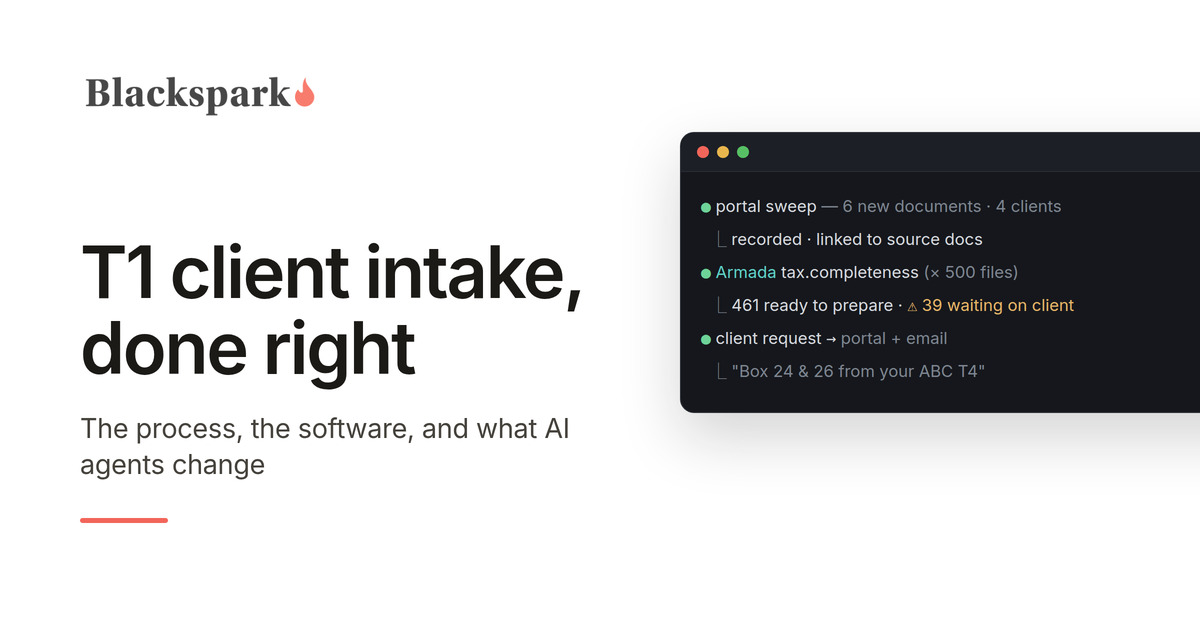
Ask a Canadian firm where tax season actually hurts and the answer is never the tax calculation. It's intake: getting each client's documents in, understanding what's there, noticing what's missing, chasing it down, and knowing - with confidence, across hundreds of files at once - which returns are ready to prepare and which are still waiting on a slip. Calculations are instantaneous; intake is weeks, and it's the stage where files stall, staff burn out, and errors are born.
This guide lays out what a good T1 intake process looks like, what to demand from client intake software, and how AI agents are changing the economics of the whole stage.
What a T1 intake process actually has to do
Strip away the tools and every firm's intake runs the same eight steps: open the engagement, request documents from the client, collect what arrives, identify each document, record its data, detect what's missing or inconsistent, follow up until the gaps close, and hand a complete package to preparation. Simple to list, brutal at volume - because steps three through seven don't happen once per client. Real intake is a long-running conversation. The client sends four documents in February, two more in March, and answers a question the day before the deadline. Multiply by five hundred clients and the real problem isn't any single step; it's state - knowing exactly where every file stands, every day, without anyone reconstructing it from an inbox.
Why the traditional toolkit breaks
Most firms run intake on email, a shared folder, a spreadsheet tracker, and a static client questionnaire. Each piece fails in a characteristic way. Email buries documents in threads and makes the follow-up trail personal to whoever sent it. Folders hold files but understand nothing about them - a folder can't tell you the T5 is missing. Spreadsheet trackers rot within weeks because they're updated by hand, by busy people. And the annual questionnaire under-collects by design: a static form asks everyone everything, gets skimmed, and still can't ask the one specific question that matters ("your donation list shows CityKidz with no amount - what was it?").
Client portals improved the collection step - documents arrive in one place, with reminders. But a portal is a mailbox with a checklist. It collects; it doesn't understand. Everything after upload - reading the slip, recording the data, spotting the gap, chasing it - is still people.
What to look for in T1 client intake software
Whether or not agents are on your roadmap, the evaluation checklist has changed. Six capabilities separate intake software from document storage:
A structured tax data model, not a file cabinet. The system should know what a T4 is - its boxes, its rules, its relationship to the return - so a document becomes recorded, validated data, not a PDF waiting for re-keying.
Validation at the point of entry. Required fields, cross-field rules, and slip-level checks should run when data is recorded, so problems surface in February, not at review in April.
Gap tracking as a first-class feature. "What's missing" should be a computed fact with an open item attached to the exact record - not a feeling, and not a column in somebody's spreadsheet.
Provenance on every number. Each recorded figure should link to the source document it came from, with the document stored alongside. This is what makes the file reviewable later without re-checking every line.
A completeness gate. The system - not the preparer's memory - should decide when intake is done: every applicable section addressed, every required field present, every open item closed, and a workflow status that won't advance until that's true.
Clean handoff. Intake feeds preparation. The output should be a structured, validated package your tax prep software and practice management stack can consume, not another folder.
The questionnaire, rethought
The static T1 questionnaire deserves its own funeral. Its replacement isn't a better form; it's gap-driven asking. When intake runs on a structured data model, the system knows precisely what's missing per client - so the client gets one short, specific request ("Box 24 and 26 from your ABC T4; the CityKidz donation amount and receipt") instead of a forty-question form. Specific asks get faster, better answers, and they stop training clients to ignore your emails.
What AI agents change
Intake is the most automatable stage of tax work, because most of it is reading, recording, comparing, and following up - exactly what modern AI agents do well. An agent can watch the portal, read each document as it arrives, record the data into the intake system, open the gap items, and send the specific follow-up request, running the whole loop daily across every client without fatigue.
But - and this is the part firms evaluating "AI intake" tools should press hardest on - the agent is the easy half. An agent with no governed system underneath will save extracted numbers into a spreadsheet, invent a value when a required field blocks it, and lose track of state between sessions. Everything in the checklist above is what makes agent-run intake safe: the data model gives the agent something structured to write into, validation catches its errors, provenance makes its work reviewable, gap tracking gives it honest ways to record what it doesn't know, and the completeness gate stops it - like any staff member - from calling a file done early.
Where Armada T1 fits
Blackspark builds Armada T1. Armada T1 is the system of record for Canadian T1 intake, with its own MCP server: the intake layer described above, which AI agents operate under governance. The Canadian tax data model, field-level validation, document provenance, task tracking, and completeness gates are the platform; your agents (or your staff) do the work on top. Armada T1 does not calculate or EFILE returns: the completed file is handed off to the CRA-certified tax software your firm already runs. For which Canadian tax and practice tools have MCP servers of their own, see our MCP server tracker.
If you're rethinking intake for next season - with agents or ahead of them - request access on our homepage.
The bottom line
T1 intake is a state-management problem wearing a document-collection costume. Firms that treat it as filing - folders, emails, trackers - pay for it every March and April in overtime and missed slips. Firms that treat it as structured data with computed completeness get something new: an intake stage that can largely run itself, with people handling only the judgment calls. That's the standard to evaluate any intake solution against this year, because it's the standard AI agents are about to make normal.
Working on US 1040 workflows? Armada 1040 is coming soon: the same record and MCP server, for US individual returns. Join the waiting list.
