
TOSI Rules: Everything You Need To Know
The tax on split income (TOSI) rules are one of the most consequential - and most frequently misapplied - parts of preparing T1 returns for owners of private corporations and their family members. Since 2018, they have determined whether dividends, trust allocations, and certain other amounts paid to a family member are taxed at that person's own marginal rate or at the top marginal rate, with most personal credits stripped away.
This guide covers how the rules work, who they apply to, the exceptions that matter in practice, and how tax preparation teams can screen for TOSI exposure systematically rather than catching it (or missing it) file by file.
What is income sprinkling?
Income sprinkling - often called income splitting - is the practice of directing income from a high-income individual to family members in lower tax brackets, most commonly by paying dividends from a private corporation to a spouse or adult children who hold shares. Before 2018, this could produce substantial family-level tax savings even when the recipients had no involvement in the business.
The TOSI rules exist to shut down that version of the strategy. Income splitting itself is not prohibited - several forms of it remain fully legitimate - but income sprinkled to family members who neither work in the business nor put capital at risk is now generally taxed as if the high-income earner had kept it.
What are the TOSI rules?
TOSI is found in section 120.4 of the Income Tax Act and has applied in its current form since January 1, 2018, when the former "kiddie tax" on minors was extended to adult family members. The mechanics are blunt: when an amount is "split income" received by a "specified individual" and no exception applies, it is taxed at the top federal marginal rate (33%, plus the top provincial rate), and the recipient loses the benefit of most personal credits against that income.
Split income includes, among other things: taxable dividends from private corporations, shareholder benefits, income allocated from a partnership or trust that is derived from a related business, income from certain debt obligations, and certain capital gains on dispositions to non-arm's-length parties.
Notably, salary is not split income - reasonable wages paid to a family member for actual work are tested under the ordinary reasonableness rules, not TOSI.
Who do the TOSI rules apply to?
TOSI applies to a "specified individual" - essentially any Canadian-resident individual, adult or minor, who receives split income where a related person (the "source individual") is actively involved in the underlying business. The classic fact pattern: one spouse runs an incorporated business, the other spouse and adult children hold dividend-paying shares.
Age matters enormously under the rules. Minors are caught in almost every scenario. Recipients aged 18 to 24 face the strictest adult tests. Recipients 25 and over have access to the widest set of exceptions, and recipients whose spouse is 65 or older get a further exception that mirrors pension income splitting.
What is the tax rate under TOSI?
Split income caught by TOSI is taxed at the top combined federal-provincial marginal rate regardless of the recipient's other income - federally 33%, with combined rates exceeding 50% in most provinces. The amount is reported on Form T1206 (Tax on Split Income) and flows to line 40424 of the T1. Because the recipient also loses most credits against that income, TOSI routinely produces a worse result than if the source individual had simply earned the income directly.
What are the exceptions to the TOSI rules? (Excluded amounts)
The exceptions - "excluded amounts" in the legislation - are where nearly all of the practical analysis happens. The four that matter most:
Excluded business (the 20-hour rule). Amounts from a business in which the recipient (18 or older) is actively engaged on a regular, continuous and substantial basis - in the current year or in any five prior years, which need not be consecutive. Working an average of at least 20 hours per week during the part of the year the business operates is deemed to meet the test. This is the workhorse exception for genuinely active family members, and the five-prior-years branch means a retired founder's spouse who put in the hours a decade ago can still qualify.
Excluded shares. For recipients 25 or older who personally own shares representing at least 10% of both the votes and the value of the corporation - provided the corporation earns less than 90% of its business income from the provision of services, is not a professional corporation, and derives substantially all its income from its own business rather than a related business. Service businesses and professional corporations are deliberately shut out of this exception, which is why it fails more often than owners expect.
Reasonable return. For recipients 25 or older, amounts that represent a reasonable return on the recipient's contributions of labour, capital, and risk assumed, considering historical payments as well. For recipients 18 to 24, only a "safe harbour capital return" (a prescribed-rate return on arm's-length capital they contributed) or a reasonable return on such capital qualifies. Documentation is decisive here - the CRA assesses reasonableness on the facts.
Age 65 exception. If the source individual is 65 or older, amounts paid to their spouse or common-law partner are excluded - deliberately aligned with pension income splitting so that business owners are not worse off than pensioners in retirement.
Beyond these four, excluded amounts also cover several specific situations: property inherited from a parent (or from anyone, if the recipient is a student or eligible for the disability tax credit), property received on marriage breakdown, taxable capital gains arising on death, and gains on property eligible for the lifetime capital gains exemption (qualified small business corporation shares and qualified farm or fishing property) - the last of which applies even to minors.
How is TOSI different from legitimate income splitting?
Several income-splitting strategies remain fully available because they never produce "split income" as defined: pension income splitting between spouses, spousal RRSP contributions, properly structured prescribed-rate loans for investment income, paying family members reasonable salaries for real work, and TFSA contributions funded by gifts between family members. A useful mental model: TOSI polices private-corporation income flowing to relatives; it does not police the ordinary tools Parliament built for household tax planning.
How should tax preparation teams screen for TOSI?
In a firm setting, TOSI errors rarely come from misreading the law - they come from intake gaps. The facts that decide TOSI treatment (hours worked per week, share percentages by votes and value, the corporation's services revenue mix, the recipient's age, the source individual's age) live with the client, not on the slips. A T5 from a private corporation looks identical whether or not TOSI applies.
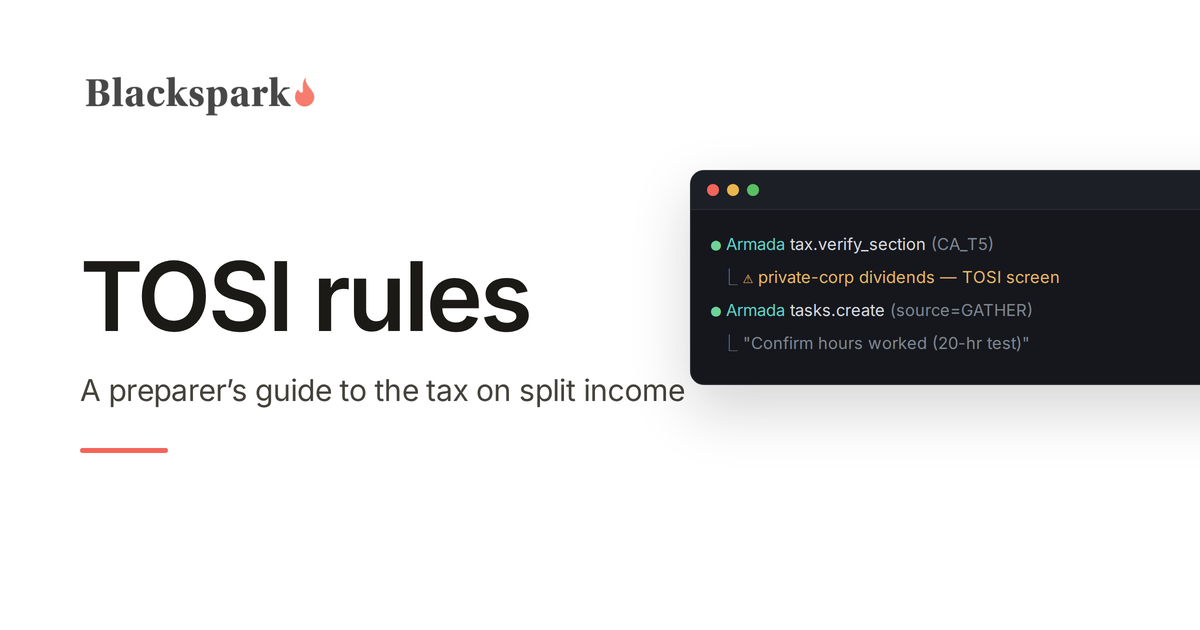
That makes TOSI a workflow problem as much as a technical one. Files with private-corporation dividends should be flagged at intake, the exception-relevant facts gathered as structured data with the client's answers documented, and a T1206 prepared whenever no exception clearly applies. This is exactly the class of problem Blackspark builds for. Armada T1 is the system of record for Canadian T1 intake, with its own MCP server, and it lets AI agents gather taxpayer information, record it as structured, validated tax data with full provenance, and open follow-up tasks automatically when a required fact - like the hours a family member actually worked - is missing from a file. Firms interested in automating intake-stage screening can request access on our homepage.
The bottom line
TOSI is settled law, not a proposal - it has applied since 2018, it taxes caught income at the top marginal rate, and the difference between a caught dividend and an excluded one usually comes down to facts a preparer must actively collect: hours worked, share structure, revenue mix, and age. Treat those facts as required intake data rather than review-stage discoveries and the rules become manageable; treat them casually and they become reassessments.
This post provides general information for tax professionals and is not tax, legal, or filing advice. Confirm positions against the Income Tax Act, current CRA guidance, and the facts of each client file before applying them.
