
Starting a Tax Preparation Business in the Agentic AI Era
There has never been a cheaper time to start a financial services practice, and there has never been a better founding service than tax preparation. Those two claims are related, and this post is the argument for both, aimed at the person we keep meeting: early in their career, credentialed or working on it, ambitious, and wondering whether to join an established firm or build something of their own.
A generation that wants to build
If that's you, you have company. An RBC poll found that 59 percent of Canadians aspire to own a business, the highest level since 2017, with more than 2.6 million already working for themselves. BDC's February 2026 study of 1,505 self-employed Canadians found the youngest cohort is the most growth-hungry of the group. And the intent is converting into action: Futurpreneur, which finances entrepreneurs aged 18 to 39, saw applications jump 50 percent year over year nationwide last fiscal quarter, and 65 percent in Alberta. Its CEO credits changing expectations around traditional employment.
There's a caution inside the same data. Statistics Canada found that Canadians aged 15 to 34 post the highest entry rates into incorporated business ownership, and also the highest exit rates. Plenty of young founders start; fewer build something that lasts. The difference is rarely talent. It's usually the business model: whether revenue recurs, whether demand has to be manufactured, and whether the founder can serve enough clients before the runway ends.
Which is exactly why the founding service you pick matters more than almost any other decision.
Why tax preparation is the keystone service
Start with the business logic, because it hasn't changed in fifty years and AI doesn't change it either.
A tax return is the one financial service almost every adult needs every single year, on a deadline the government enforces for you. Nobody needs to be convinced to file; they only need to be convinced to file with you. That is a far easier sale than any other financial service, where the first job is persuading someone they need the product at all. You still have to win clients, but you're competing for demand that already exists and renews annually by law.
More importantly, look at what you hold after preparing someone's return. Their income and how it's earned. Their RRSP room and whether they use it. Their dependants. Their donations. Their side business and what it actually makes. Their capital gains, their debts surfacing through interest deductions, their marital changes, their approaching retirement. A completed T1 is the most complete financial snapshot of a household that any professional ever legitimately assembles.
Every other financial service is downstream of that snapshot. Retirement planning starts with the RRSP room you can see. Insurance conversations start with the dependants and the mortgage interest you can see. Investment advice starts with the unregistered account activity you can see. Firms have always known this: tax preparation is rarely the most profitable service in the building, but it is the service that makes every profitable conversation possible.
The catch, historically, was that the keystone came with a grind attached. Tax season meant gathering documents, keying slips, chasing clients for the forms they forgot, and re-checking everything under deadline pressure. To hold five hundred client relationships you needed a staffed back office, and to afford a staffed back office you needed five hundred clients. That loop is what kept new entrants out.
The grind is now delegable
That loop just broke, and this is the part that matters if you're starting today.
AI agents can now do the intake grind: read the documents clients send, build structured tax records, notice what's missing, chase it politely and persistently, and assemble reviewer-ready files. Not as a demo, but as governed workflow, provided the agents work on infrastructure built for them, with validation on every write, provenance on every number, and tracked gaps instead of invented ones.
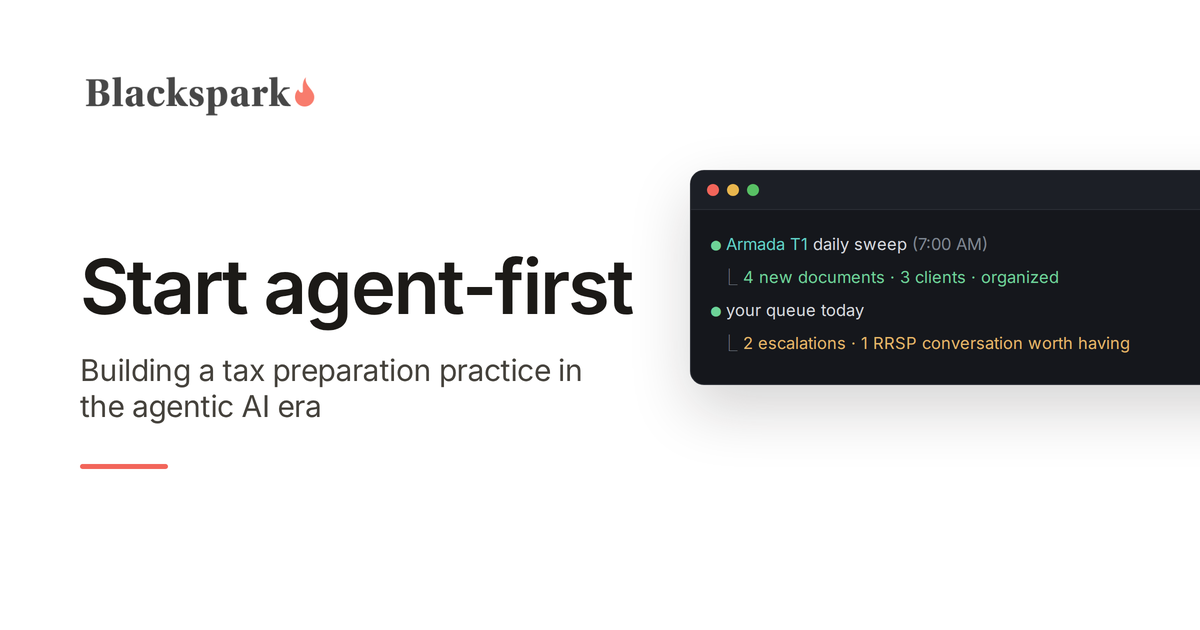
That's what we build. Armada T1 is agent-ready infrastructure for Canadian T1 workflows: AI agents operate the intake, and the platform governs what they're allowed to do and what counts as done. A morning agent sweeps the intake folder and organizes new client documents. A chase agent works the missing-items list. A review agent packages completed files, and a handoff agent moves them into filing software. Those aren't hypothetical job titles. They're the workflow roles a small firm staffs with people, available to you as software.
The strategic consequence is simple: the back-office loop that kept solo practitioners small no longer binds. One licensed professional with an agent-first setup can hold a client book that used to require a team, because the work that required the team is exactly the work agents do best.
Agent-first beats agent-later
Here's the advantage you have over every established firm, and it's worth taking seriously because it's temporary.
Existing practices are retrofitting. They have desktop software, staff trained on manual process, folders full of habits, and busy seasons that punish experimentation. Most will automate slowly, around the edges, without changing shape. You have no legacy process to protect. You can design the practice around the agents from day one: intake that lands in structured, validated records instead of a shared drive; follow-ups that happen automatically instead of when someone remembers; a completeness gate that decides when a file is ready instead of a feeling. You inherit none of the eleven-p.m. re-keying because you never build the workflow that requires it.
Being small stops being a disadvantage. It becomes the moat: you can be agent-first while the incumbents are agent-eventually.
What the agents don't do
An honest list, because the pitch falls apart without it.
Agents don't hold the relationship. The client trusts a person with their finances, and that person is you. Agents don't exercise professional judgment on ambiguous situations, and the good ones are built to escalate rather than guess: the missing box, the receipt that could be two things, the residency question. Those land in your queue, which is the point. Your day is judgment and conversations; the agent's day is everything else.
And agents don't carry your obligations. You still register with the CRA for EFILE, you still meet whatever licensing applies to the services you offer, and if you plan to sell insurance or investment products you need the corresponding provincial licensing before a single conversation happens. AI compresses the grind, not the responsibility. Frankly, that's also why this opportunity is real: the credentials and accountability are the part that can't be automated away, and you're the one bringing them.
The flywheel, from the first client
Put the pieces together and the model looks like this. Tax preparation acquires clients at a lower cost than any other financial service, because the demand already exists and comes back every spring. Agents do the intake, the chasing, and the assembly, so each client costs you minutes of judgment instead of hours of clerical work. The completed return gives you, with the client's consent, the most complete picture of their financial life available anywhere. And that picture is a standing list of conversations worth having: the unused RRSP room, the new baby and no life insurance, the side business ready to incorporate, the retirement five years closer than the portfolio assumes.
Each of those conversations is a planning engagement, an insurance policy, or an investment relationship. Higher margin, deeper trust, and all of it anchored by the keystone service that brings the client back every spring. The old constraint was that you couldn't afford to offer the keystone until you were big. Now the keystone is the cheapest thing you offer.
Starting stack
What this looks like practically: your credentials and registrations, a client-facing identity, filing software for the returns themselves, and Armada T1 as the system of record your agents operate. From there, add clients, not headcount.
We're building for exactly this founder. If you're starting an agent-first practice, request access on our homepage.
This post provides general information and is not tax, legal, licensing, or business advice. Confirm CRA registration requirements and provincial licensing rules for any regulated products before offering services.
