
Why Not Just Point an Agent at the Intake Folder?
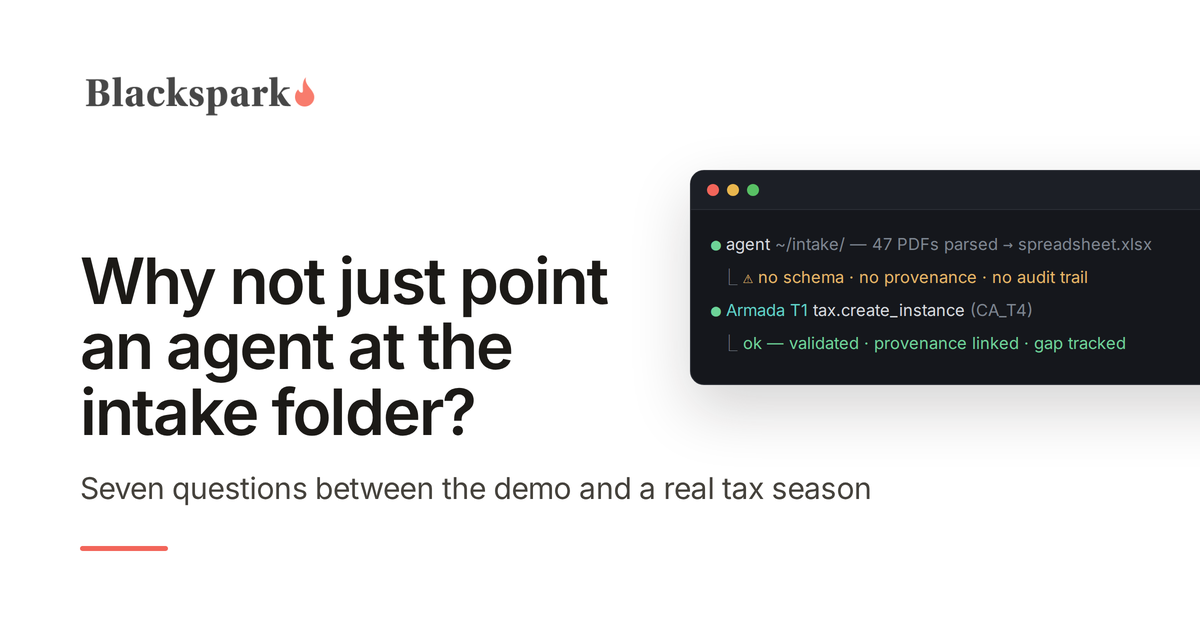
If you build agents for a living, you've already had this thought: tax intake looks easy. Claude or GPT can read a T4 PDF flawlessly. Give an agent access to the client's document folder, a decent prompt, and a spreadsheet to write into, and you've automated intake. You can build that demo in a weekend, and it will genuinely work — in the demo.
We know because that demo is roughly where every conversation with an implementer starts. This post is the list of questions that separate that weekend demo from something a Canadian accounting firm can actually run a tax season on. It's also, not coincidentally, the list of reasons Armada T1 exists.
Where does the data go?
An agent that extracts slip data has to put it somewhere, and the somewhere is the whole game. A spreadsheet or a JSON file has no schema, so every extraction decision the model makes — field names, formats, what counts as box 26 — is improvised per document. Across five hundred returns and three agent versions, you get five hundred slightly different improvisations.
A 2025 T4 has more than eighty typed fields, with CRA box mappings, picklists, and conditional relationships. And it's different from the 2024 T4, because the schema changes every year. Somebody has to own that structure. If it isn't your platform, it's your prompt — which means it's nobody.
What stops the agent from making things up?
This is the question that should keep implementers up at night, and the answer can't be "we prompted it not to."
Here's the mechanism nobody designs for on purpose. Real client documents are incomplete — the T4 arrives without box 26, the receipt is missing a date. If your pipeline validates strictly, records that fail validation don't save. An agent that can't save its work will, sooner or later, fill the gap with something plausible to get past the gate. Strict validation, applied naively to agents, teaches them to fabricate. And a fabricated number in a tax return isn't a UX bug; it's a professional liability event.
The alternative isn't no validation — it's validation designed for how agents actually work. In Armada T1, an honest partial record always saves, and every gap and rule violation is tracked against it as explicit, field-level debt. The agent never faces a choice between losing its work and inventing a number. The gaps then surface at a verify boundary, and an incomplete file cannot advance in the workflow. Truth is enforced by architecture, not by prompt.
Where did this number come from?
A reviewer looking at agent-built work has one overriding question: can I trust it? A spreadsheet row can't answer that. In Armada T1, every record carries a provenance link to the source document it came from — the specific slip, receipt, or CRA import. That single design decision is most of the difference between "the AI filled in a spreadsheet" and "here's an audit-ready file a reviewer can sign off on."
What happens over six weeks?
The demo processes a folder in one sitting. Real intake is a long-running conversation: the client sends four documents in February, two more in March, and answers a question the day before the deadline. A generic agent has a context window; it doesn't have durable state. Armada T1 is the state: tax files with explicit workflow statuses, open tasks anchored to the exact record they're about, and a completeness picture that any agent — or human — can pick up cold, weeks later, mid-stream. The third session doesn't need to re-derive what the first two did.
Who is allowed to do what?
Point an agent at a folder and you've granted it everything, invisibly. There's no identity, no scoping, no record of what it read or wrote. That's fine for a demo and untenable for a firm handling SINs and income data under professional obligations. Armada T1 treats agents as first-class principals: identified as agents, scoped to one firm's tenant, permission-bounded, with every call logged. When the reviewer, the partner, or eventually the regulator asks what the agent did — there's an answer.
Who says it's done?
In the folder-and-spreadsheet version, "intake is complete" is a feeling. In Armada T1 it's a computed fact: a file-level completeness check across every applicable section — missing required fields, rule violations, unresolved sections — and a workflow gate that refuses to advance the file until the inputs are actually clean. The gate applies to agents and humans alike. This is what we mean by "agents operate, Armada governs": the agent does the work; the system decides what counts as finished.
And then what?
Intake isn't the destination. The structured file has to land in the tax preparation and practice management software the firm already runs. A spreadsheet gets re-keyed by a human, which quietly deletes most of the value the agent created. Armada T1's endpoint is a structured, validated, provenance-linked file built for handoff.
The build-vs-buy math
None of the above is exotic. A strong team could build all of it: the versioned Canadian tax data model, the CRA-parity validation rules, the provenance layer, the task system, the workflow gates, the permissions and audit. That's the point — it's not a weekend demo, it's a multi-year system of record in a domain where the schema shifts annually and the cost of a wrong number is measured in reassessments and errors-and-omissions claims.
Here's the thing about the agent layer: harnesses are becoming a commodity. There are hundreds of them, the frontier labs give them away, and every quarter the models get better at operating whatever surface you hand them. The scarce asset in an agentic tax stack isn't the agent — it's the governed surface the agent operates. Our own testing bears this out: a general-purpose model with a two-page instruction file runs a clean, auditable intake on Armada T1, because the guarantees live in the platform, not the prompt.
So build the part where you differentiate: your orchestration, your client experience, your firm-specific workflows. Point it at a system of record that already knows what a T4 is, refuses to let anyone — agent or human — call an incomplete file done, and never gives your agent a reason to invent a number.
That's the division of labour Armada T1 proposes. If you're building on it — as a consultancy, an MSP, or a firm's internal team — request access on our homepage.
This post provides general information for tax professionals and agent implementers and is not tax, legal, or filing advice.
