
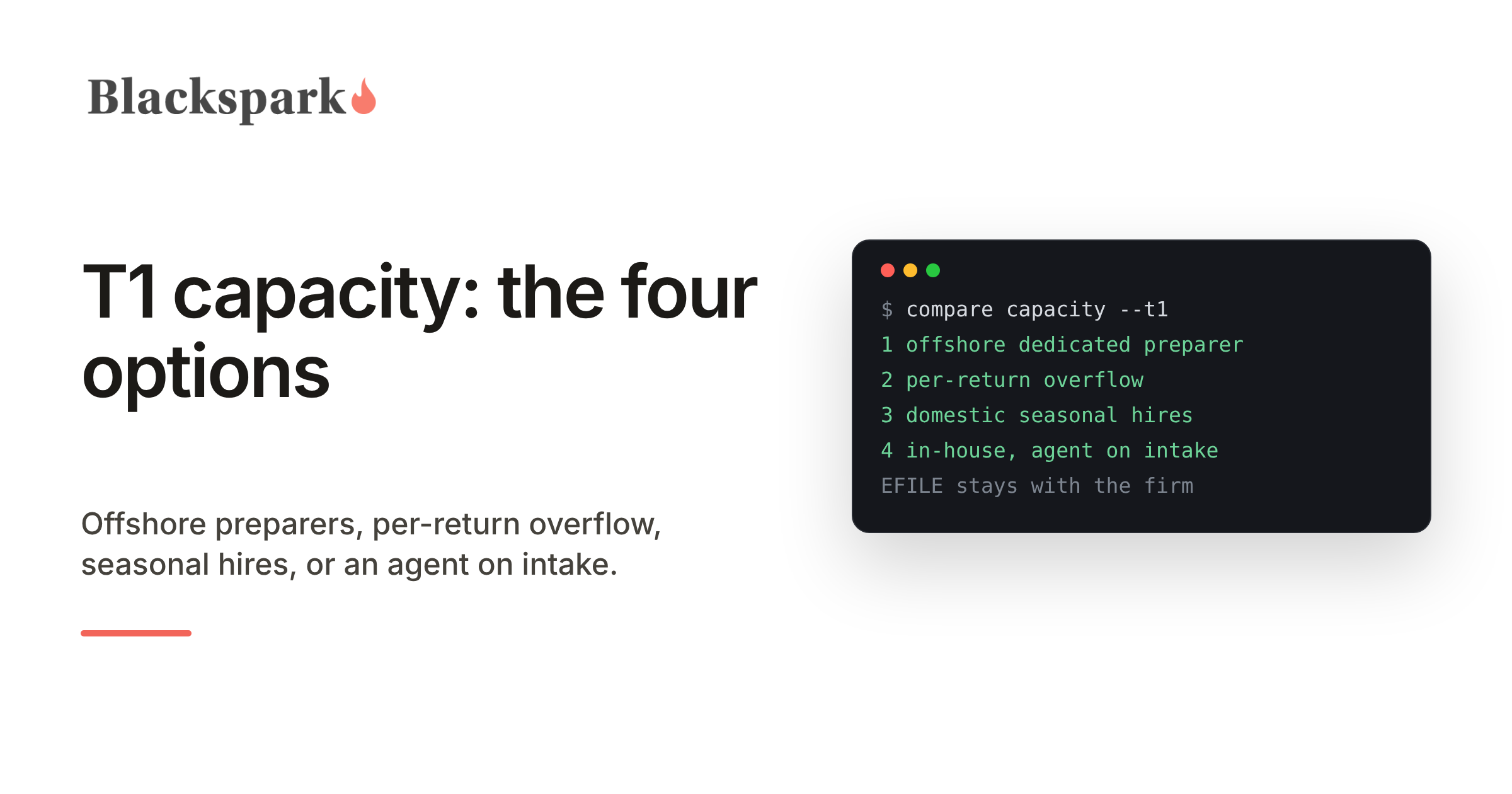
Every Canadian firm that prepares personal returns has the same shape of problem: between the end of February and the end of April there are more T1 files than hours, and for the rest of the year there are not. Firms search for "tax preparation outsourcing" because that is the name the market has given the fix, but outsourcing is one of four ways to buy the missing hours, and the one most firms have not priced is the one that keeps the work inside the firm. This page sets the four side by side: what each costs, what each asks of the firm, what each does to the client's data, and the one thing none of them can take off the firm's hands.
The problem is capacity, not expertise
A T1 practice does not run short of judgment in March. It runs short of hands for the first stage of preparing each return, the intake: receiving the slips, opening them, reading them, keying the boxes, noticing what is missing, asking the client for it, asking again, and checking that what came back matches what was asked. On most files that stage is the majority of the hours and almost none of the professional risk. The second stage, deciding how to treat what the slips show, completing the return in the tax software, reviewing it, signing it and filing it, is a smaller share of the hours and carries all of the risk. Any capacity option should be judged on which of those two stages it absorbs.
Option one: an offshore dedicated preparer
This is what most of the providers a firm finds by searching are selling: a preparer, or a team, in India or the Philippines, working inside the firm's own tax software for a monthly fee or an hourly rate. Our survey of twenty-three providers that sell to Canadian firms found published rates starting around USD 10 to 15 an hour, CAD 15 at one provider, and dedicated staff from roughly USD 3,000 a month, with most providers quoting on request. Sixteen of the twenty-three document T1 preparation; six name Canadian tax software such as TaxCycle, ProFile or CCH iFirm Taxprep on their Canada pages, and the rest name QuickBooks and Xero or US packages, which tells a firm how much Canadian work the provider has actually done. The full list, with what each provider's own site says, is in Canadian T1 outsourcing providers.
The saving is real and the providers are candid about where it comes from: a preparer in Ahmedabad costs a fraction of one in Mississauga, and the "up to 60%" figure that several sites quote is a wage difference, not an efficiency. What the firm takes on in exchange is the client's data leaving the country. Under PIPEDA the firm remains accountable for personal information it transfers to a third party for processing, wherever that third party is, must use contractual or other means to give it a comparable level of protection, and must tell clients their information may be processed outside Canada and be accessible to foreign authorities. CPA Ontario's Rule 208 adds that confidential client information is disclosed only with the client's consent, preferably in writing, or where law or professional duty permits. A firm that sends slips offshore needs a contract with the provider, a consent from the client and a line in its privacy notice, all in place before the first file moves. Most providers will say they are used to this; the obligation is still the firm's.
This option absorbs both stages, the intake and the return itself, which is its appeal and its risk. A good offshore preparer delivers a prepared return. The firm still reviews it, and a return prepared by someone the firm has never met is reviewed more slowly than one prepared down the hall, at least for the first season.
Option two: per-return or seasonal overflow
Some providers, and some Canadian firms with spare capacity, sell preparation by the return rather than by the preparer: send the file, get back a prepared return, pay a fixed amount. It suits a firm whose overflow is a few hundred files rather than a few thousand, because there is no commitment beyond the files sent. The privacy obligations are identical to option one if the provider is offshore, and lighter but not absent if it is a Canadian firm, since the client's consent to share with a third party is still required.
The practical limit is turnaround. Per-return providers queue files, and in the last three weeks of April everyone's queue is long. A firm that depends on overflow for its April files is depending on someone else's April.
Option three: domestic seasonal hires
The traditional answer is to hire preparers from January to April, often the same people each year: retired practitioners, students, bookkeepers with a tax season habit. The data stays in the office and under the firm's own controls, the consent question does not arise, and the firm can watch the work. The costs are the ones every firm knows: recruiting against every other firm in the city at the same time, training people on the firm's software and conventions in the busiest month, supervising them, and losing the ones who were good to a permanent job somewhere else. Seasonal staff also absorb the same mix of work as the firm's own preparers, which means a seasoned hire spends a large share of their expensive hours on the intake chase.
Option four: keep the work in-house and put an agent on intake
The fourth option separates the two stages and automates the one that is not judgment. An agent, running on the firm's own Claude plan, connected to the practice management system the firm already uses and to a system of record for the tax file, reads each document as the client uploads it, records the slip and receipt data as validated records with the source document attached, works out what is still missing, and turns each gap into a task for the preparer or a request to the client in the firm's own portal. The preparer sees a file that is either complete or has a named list of what is not, and spends their hours on the file rather than on the chase. The client sees the portal they already use. No one is hired, and nothing leaves the firm's systems.
Armada T1 is the system of record for Canadian T1 intake, with its own MCP server. It holds the tax file, validates every value the agent records against the year's T1 input schema, keeps the source document with each record, and says what is still missing, so that whether a file is complete has one answer on every file in the firm, not a preparer's feeling about each one. We have run this end to end on TaxDome and on Karbon; the guides for each are Claude with TaxDome for T1 season and Claude with Karbon for T1 season. Armada T1 does not calculate or EFILE returns; the completed file is handed off to the CRA-certified tax software your firm already runs.
This option absorbs the intake stage only. It does not replace a preparer; what it replaces is the hours a preparer, seasonal or offshore, would have spent getting the file to the point where their judgment is needed. For a firm whose constraint is preparers, it is not a substitute for options one to three; it is the thing that makes each of them go further, because the preparer, wherever they sit, starts from a complete file with provenance instead of a folder of uploads.
The thing none of them can take off your hands
EFILE transmission belongs to the registered EFILE number, which is the firm's. Whoever did the intake and whoever completed the return, a provider, a seasonal hire or an agent, the firm reviews, signs and files, and carries the professional responsibility for what it filed. Whatever option a firm chooses, that is where the season ends.
How to decide
A firm short of preparers and comfortable with the privacy work will look first at option one and should read the provider list with the software line in mind. A firm short of a few hundred hours, not a few thousand, will look at option two or three. A firm whose preparers are spending March on intake should look at option four before it buys more preparer hours, because that is the option that changes what the hours are spent on. The options are not exclusive; a firm that outsources the return and runs agent intake hands its provider a complete file with every source attached, which is a better file than most providers receive.
If you prepare T1s and want to see what agent-run intake looks like on your own systems, request access on our homepage.
This post provides general information for tax professionals and is not tax, legal, or privacy advice. Provider counts, rates and claims are as published on the providers' own websites in November 2026 and may change; PIPEDA and CPA Ontario references are general summaries, not legal advice. Company names are trademarks of their respective owners.
