
T1 Intake Checklist for Accounting Firms: The List You Give Clients, the Checks You Run When It Arrives, and What an AI Agent Does With Each
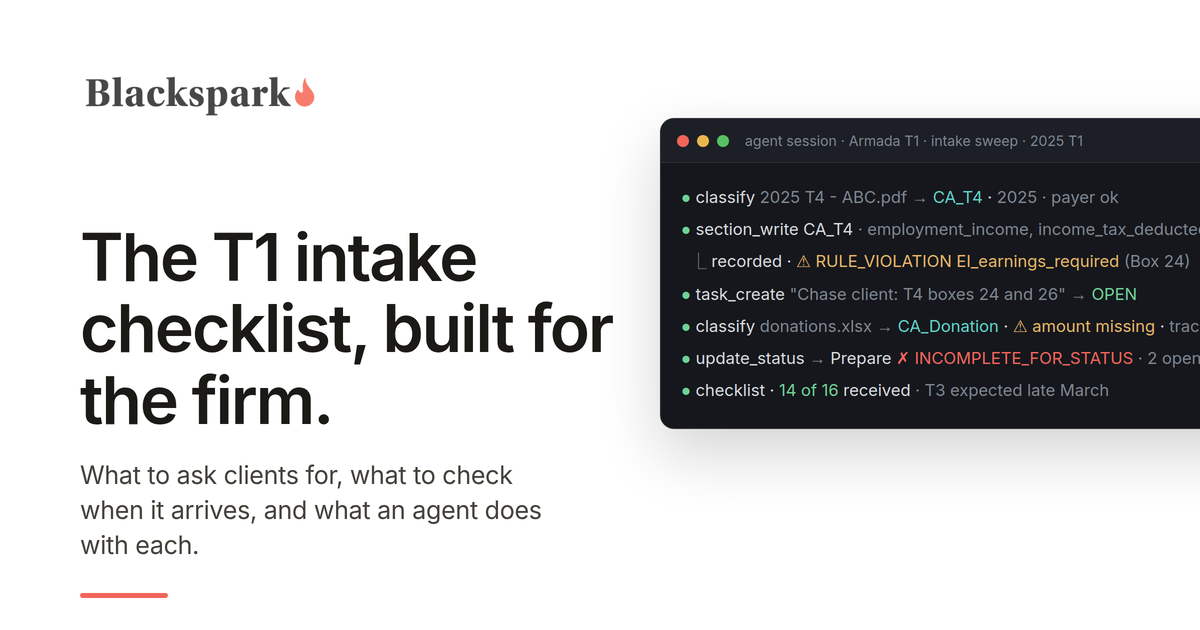
Most T1 checklists online are written for the taxpayer. The ones firms actually use are two lists that have grown together over years of tax seasons: a client-facing organizer that says "send us these," and an unwritten firm-side list of what to check when each item shows up. This post separates them on purpose. The first part is a client checklist you can lift into your own organizer, in plain language, with no box numbers. The second is the firm's layer: what a preparer verifies on each document before it becomes a number in a file. The third is what changes when an AI agent runs that second layer for you.
Part one: the client checklist
Written to be copied, for the 2025 tax year. Trim it to your client base and add your province's specifics. "2025" means January 1 to December 31, 2025, unless an item says otherwise.
Or download the editable Word version, which has this checklist and the 56-question questionnaire in one document.
About you and your household
Your legal name as the CRA has it, date of birth, social insurance number, current address and the date you moved there, and the phone number and email you want us to use. Your occupation. Your marital status on December 31, and if it changed during the year, the date and a copy of any separation agreement. Your spouse or partner's name, date of birth, SIN, and their net income for the year if we are not preparing their return. For each dependant: name, date of birth, relationship, their income if any, and whether they have a disability tax credit certificate (Form T2201) approved by the CRA. Whether you supported a relative who depends on you because of a physical or mental impairment, with or without a certificate. Whether you are a Canadian citizen, and whether you, your spouse, or a dependant is also a citizen or permanent resident of another country, including the United States, or spent significant time there; there are separate filing questions we will walk through with you.
CRA administration
Your prior-year notice of assessment or reassessment. Any letters from the CRA during the year. Instalment payments you made and the CRA's instalment reminder. Whether your CRA direct deposit is set up and current; since March 24, 2025 the CRA no longer accepts enrolments or changes through tax preparers' EFILE software, so you or your legal representative set it up in your CRA account, through your bank, or with the CRA's paper form, and we do not collect bank details. Your answers to the consent questions on the return: if you are a Canadian citizen, whether the CRA may give your name, address, date of birth, and citizenship confirmation to Elections Canada, and, in provinces and territories that take part (including Ontario, Nunavut, and, from 2025, Alberta), whether the CRA may share your contact information with the organ and tissue donation program so it can send you information. And if we do not already have it, authorization for us to access your CRA account on your behalf: we request it through Represent a Client and you confirm it in your CRA account within 10 business days, or you give us details from a notice of assessment at least six months old and sign a certification page. Authorization lets us pull many of your slips directly.
Income slips
Send every slip you received, even ones you think do not matter. Employment (T4). Pension, retirement, and other income (T4A). Canada Pension Plan (T4A(P)) and Old Age Security (T4A(OAS)). Employment Insurance (T4E). RRSP and RRIF withdrawals (T4RSP, T4RIF). First Home Savings Account (T4FHSA). Investment income (T5), trust and mutual fund income (T3), securities sold (T5008), and partnership income (T5013). Any US slips (W-2, 1099, 1042-S). If you live in Quebec or worked there, the Relevé slips as well. If you had employment income with no slip, ask the employer for it and check your CRA account, where employer-filed slips appear; if it still has not arrived when we are ready to file, send us your final pay stub and we will determine the amounts to report.
Investments and property
For anything you sold, exchanged, gave away, or spent during 2025 that was not inside an RRSP, TFSA, or FHSA (shares, funds, real estate, cryptocurrency including one coin exchanged for another, private company shares): what it was, when you bought it, what you paid, what you received, and the costs of buying and selling. Your broker's annual realized gain and loss report if you have one. Whether you sold a home you or your family ever lived in while you owned it, or changed a home from personal use to rental or the reverse. Whether you sold a Canadian residential property, or sold or assigned a right to buy one, that you had held for less than 365 consecutive days. Whether the total cost of investment property you hold outside Canada (foreign bank accounts, foreign shares including US stocks held at a Canadian broker outside a registered plan, foreign rental property, money owed to you by non-residents; not a vacation home you use yourself) was more than $100,000 Canadian at any time in 2025. Any interest in a foreign corporation or trust that is not publicly traded. Any stock options exercised.
Self-employment and rental
For a business or professional practice: your bookkeeping export or financial statements, bank and credit card statements for the business, your GST/HST registration number and whether you want us to prepare that return, capital assets bought or sold, a vehicle log with total and business kilometres, and your home office square footage. For a rental property: the address, who owns it and in what percentage, days of personal use, gross rents, expenses by category, capital improvements, and the purchase or sale documents if you bought or sold it this year. If any of it was rented or offered for stays of less than 90 consecutive days (Airbnb, VRBO, and similar): the dates it was offered that way, whether that use was permitted where the property is, and the dates any required municipal or provincial licence, permit, or registration was in effect.
Receipts for deductions and credits
RRSP contribution receipts for March 4, 2025 to March 2, 2026 (the deadline moved to March 2 because the sixtieth day fell on a Sunday), any Home Buyers' Plan withdrawal or repayment details, and whether you opened your first FHSA, contributed to one, or transferred into one during 2025, since opening one must be reported even with no contributions. Union and professional dues not already on your T4. Child care receipts showing the provider's name, address, and SIN or business number. Spousal or child support paid or received, with the agreement if it is new or changed. Interest paid on money borrowed to invest, and investment advice or management fees on non-registered accounts. Moving expenses if you moved at least 40 kilometres closer to a new job, a business you run, or full-time post-secondary study. Legal fees paid to collect salary, pension, or support owed to you. If you paid work expenses your employer did not reimburse or worked from home under an arrangement with your employer (a voluntary formal telework arrangement counts): the receipts, your home office details, and Form T2200 completed by your employer, which most of these claims require. Tuition certificates (T2202, or TL11A for a university outside Canada), student loan interest statements, and whether a student wants to transfer unused tuition to a parent or spouse. Official receipts for charitable and political donations, and a note of any donations made between January 1 and February 28, 2025 that were already claimed on your 2024 return under the extension, since they cannot be claimed again. Medical expense receipts with payment dates, including private health plan premiums and any insurer reimbursement statements, so we can choose the twelve-month period ending in 2025 that gives the best claim, and attendant care details if applicable. Whether you or your spouse bought a home during 2025, and whether either of you lived in a home you owned at any time from 2021 to 2025; a home bought for someone eligible for the disability tax credit may qualify for the home buyers' amount even if you have owned before. Receipts for home accessibility or multigenerational home renovation work. Whether you completed 200 or more hours as a volunteer firefighter or search and rescue volunteer. Your property tax bill or total rent paid, for provincial credits.
Questions about your year
Yes or no, and details where yes. Did you get married, separate, or have a child? Did anyone in the household become disabled, start post-secondary education, or turn eighteen? Did you move, or change province? Did you arrive in or leave Canada? Did you buy a home, sell a home you ever lived in, or start renting out a home you used to live in? Did you start or stop a business, a rental, or a side income? Did you work from home under an arrangement with your employer, and has your employer completed a T2200? Did you receive income from outside Canada? Did you make instalment payments? Did you exercise stock options, or receive employee shares? Did you withdraw from an RRSP under the Home Buyers' Plan or Lifelong Learning Plan? Did you contribute more to your RRSP or TFSA than your limit?
That is the client list. Everything below it is the firm's job.
Part two: what the firm checks when each item arrives
This is the layer no organizer prints and every experienced preparer carries in their head. It is where intake succeeds or fails, and it is the part an agent can take over.
Authorization first. A representative authorization on file means most employment, pension, benefit, and investment slips can be pulled through Auto-fill my return before the client has finished reading the checklist. Reconcile what the client sends against what the CRA has; the differences are the interesting part.
T4: boxes 24 and 26. Employment income, contributions, and tax deducted are rarely wrong. EI insurable earnings (box 24) and CPP or QPP pensionable earnings (box 26) are the two boxes most often left blank on employer-prepared slips, and the CRA requires them whenever boxes 18 or 16 have an amount. A T4 with either blank is a gap to chase, not a slip to enter. From 2024, boxes 16A and 17A carry the second CPP or QPP contributions; older templates that do not have a place for them will lose the number.
T4A: what kind of income. An amount in the fees-for-services or commissions box means self-employment income and a T2125, whatever the client ticked on the organizer.
T3: not yet. Trusts and funds have 90 days after year-end to issue T3s, so they routinely arrive at the end of March. A file that looked complete on March 10 and holds a mutual fund account is not complete; the check is "does this client have an account that will produce a T3," not "did a T3 arrive."
T5008: box 20 is not the cost base. The CRA's own T5008 guide says the cost or book value in box 20 may not reflect the investor's adjusted cost base, and on many broker slips it is blank. Proceeds without a verified cost base are a gap. The broker's realized gain and loss report or the client's purchase records fill it.
Joint accounts. T5s and T3s on joint accounts are issued in one name. The split follows who contributed the funds, and it has to be asked, not assumed from whose name is on the slip.
T4FHSA is the receipt, and opening counts. The slip reports the year's FHSA contributions and transfers; the deduction is claimed through Schedule 15, and a client who opened their first FHSA in 2025 has to file the schedule even with no contributions. There is no first-sixty-days rule for the FHSA. Asking the client for a separate FHSA contribution receipt sends them looking for something that does not exist.
RRSP: two receipt periods and an exact date. For the 2025 return the window is March 4, 2025 to March 2, 2026 (the sixtieth day was a Sunday, so the deadline moved to Monday). Contributions in the remainder of the calendar year and contributions in early 2026 come on separate receipts, and the second batch is the single most common missing document in April. Early-2025 contributions already reported on the 2024 Schedule 7 are not reported again.
T2200 before expenses. For nearly every employment expense the CRA requires the client to keep a completed T2200 from the employer. No T2200, no expense review; that check comes before the receipts, not after. A voluntary formal telework arrangement satisfies the "required to work from home" condition, so ask about the arrangement and the form separately.
Child care receipts must identify the provider. Name, address, and SIN or business number. A receipt without them will not survive review.
Donations: check the 2024 extension. Gifts made up to February 28, 2025 could be claimed on the 2024 return; anything claimed there cannot be claimed again for 2025. Ask before entering January and February 2025 receipts.
Medical: the period ends in 2025. Any twelve months ending in the tax year, chosen by the preparer from the payment dates, with nothing already claimed on a prior return.
Principal residence sales must be designated. Since 2016 the exemption is only allowed if the disposition is reported and designated on the return, and a late designation can carry a penalty. "Did you sell a home" is a question on every file.
Property held under a year. A residential property, or a right to buy one, sold after less than 365 consecutive days is generally taxed as business income, not a capital gain, unless a life-event exception applies. Assignment sales count. The question has to be asked before the lawyer's statement is entered as a disposition.
Short-term rentals. For stays of less than 90 consecutive days, expenses for any part of the year the property was not compliant with local licensing, permit, and registration rules are denied in proportion to the non-compliant days. The year-end relief that deemed a property compliant for all of 2024 does not apply to 2025, so the dates matter, not just a yes or no.
T1135 is its own deadline. Specified foreign property with a total cost over $100,000 at any time in the year triggers the form, and the penalties for missing it run separately from the return. US stocks in a Canadian non-registered account count; the same stocks inside an RRSP or TFSA do not, nor does personal-use property such as a vacation home, and the year a client first became resident is exempt. The client answers the cost question; the preparer decides whether the form applies.
Provincial inputs. Rent or property tax for the Ontario Trillium Benefit and similar credits elsewhere; each province adds two or three items to the list, and they change more often than the federal ones.
Audit the list itself every year. Credits expire. The digital news subscription credit, for example, was only available for the 2020 to 2024 tax years, yet it is still on organizers being sent out for 2025 because somebody updated the year in the header and nobody re-read the credits page. A checklist maintained by search-and-replace drifts.
Part three: what an AI agent does with each item
Everything in part two is a rule. Rules are what agents run well, provided the system underneath them refuses to be sloppy on the agent's behalf. Here is how that works in Armada T1.
Every document is classified before it is read. A T4 is a T4 for a specific employer and a specific year. A slip for the wrong year, or for a client with the same name, is held and flagged rather than recorded. The agent works from the document, not the filename or the checkbox the client ticked.
Every number is validated at the point of entry. A T4 is recorded as a structured section record, not a PDF in a folder. Fields the section does not have are rejected by name. A blank box 24 or box 26 produces a rule violation attached to that record, so the slip is in the file with its gap visible rather than silently incomplete. Every figure stays linked to the stored source document it came from.
Every gap becomes a tracked item with an owner. The missing box, the charity with no amount, the T5008 with no cost base, the T3 that has not arrived: each becomes a task. Client-held gaps route to the preparer to chase by email or text, or to the client directly where the firm's practice management platform has client requests. Judgment calls stay with the preparer as notes, not tasks.
The file cannot advance past what the data supports. Moving a file to "ready to prepare" runs a completeness check that names every open item. If it refuses, that is the system working. When the last gap closes, the file moves, and calculation and filing proceed in the firm's CRA-certified tax software exactly as they always have. Armada T1 does not calculate or EFILE returns; it does the preparation work that comes before.
Every run is repeatable. When new documents arrive, the agent recognizes what it has already processed, records only what is new, and resolves the gaps the new documents fill. The second run in late March, when the T3s land, is cheaper than the first run in February, not a repeat of it.
The client list stops being a PDF. The questions in part one become facts on the file, asked once and recorded with a date, so nobody asks them again in April, and the list itself lives in one place where retiring an expired credit is one edit rather than a re-issued document.
We have written up two of these builds in detail: one for a firm whose practice management platform has an API, and one for a firm on Jetpack Workflow and Google Drive, which has no API at all. The checklist is the same in both; only the plumbing differs.
Using this checklist
Take part one, trim it, add your provincial items, and send it however your clients answer best. Keep part two for the preparers, and decide who runs it. If the answer is still a staff member with a spreadsheet and an inbox, the T1 client intake post covers why that breaks under volume and what to look for instead. If you want to see an agent run part two against real slips, with the validation and the gap tracking underneath it, request access to Armada T1.
This post provides general information for tax professionals and is not tax, legal, or filing advice. Slip box numbers, forms, and thresholds reflect CRA guidance for the 2025 tax year as published in September 2026; confirm current-year rules against the CRA's own publications before relying on them.
