
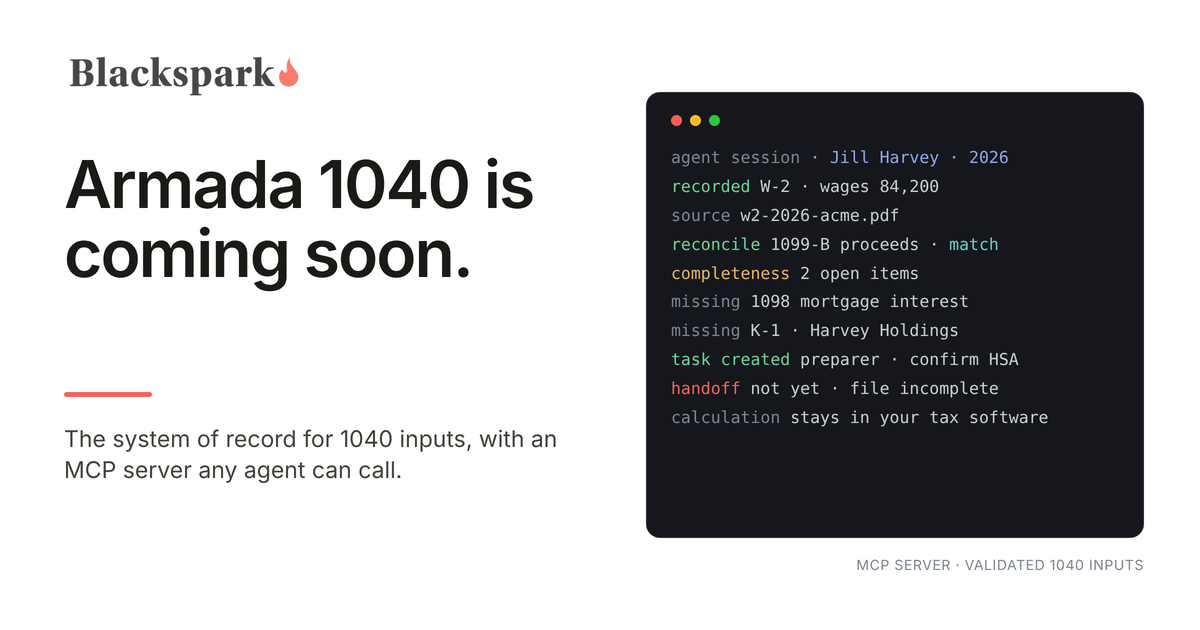
Armada 1040 is coming soon. It is the system of record for 1040 inputs, with an MCP server any agent can call. Every input is validated against the complete 1040 input schema before calculation. It does not calculate or file; the completed, document-backed file is handed off to the tax software your firm already runs. The waiting list is open for firms, developers and partners who want early access to the beta and the developer sandbox.
This post explains what that sentence means in practice: what the record holds, what the product deliberately does not do, why we built a record rather than another agent, and where it sits in the stack a US firm already runs.
What the record holds
A 1040 is built from inputs: the forms a client receives, the answers only the client can give, and the facts a preparer confirms along the way. Today those inputs live in a dozen places, a portal upload here, an email there, a note in the practice management system, a figure typed straight into the tax software. Nothing holds the whole set, and nothing knows when the set is complete.
Armada 1040 holds that set as a structured record. For each client and tax year it keeps the sections a return can have, the fields each section requires, which sections apply to this client, which fields are filled and which are still open, and the source document behind every figure. A W-2 is not a PDF in a folder; it is a set of fields, each carrying the document it came from and the moment it was recorded. The same is true of a 1099-INT, a 1099-B, a K-1, a 1098, a mortgage statement, a charitable receipt, and the answers to the questions a tax organizer would have asked.
Three properties make the record trustworthy enough to prepare from. Validation: a write that does not fit the schema is rejected by name, and a rule violation, such as an amount that cannot exist without its companion field, is refused rather than stored. Reconciliation: figures that should agree across documents are checked against each other, and a mismatch becomes an open item rather than a silent choice. Completeness: the record can say, at any moment, whether this file has everything a return needs, and if not, exactly what is missing and why. That last property is what separates a system of record from document storage, and it is the test we apply to every tool on our US scoreboard.
What it does not do
Armada 1040 does not calculate tax and does not file returns. When the record is complete, the file is handed off to the tax software your firm already runs, whether that is UltraTax CS, Lacerte, ProConnect, ProSeries, Drake or CCH Axcess, and the preparer's software does what it is certified to do. Your preparers keep their software, their review, and their signature.
It does not contact clients. When an agent working in Armada 1040 finds a missing document or an unanswered question, it records a task for the preparer or for the client, and your firm's existing channel, whether that is a portal, an email or a phone call, carries it. Agents never send a client anything directly.
And it is not an agent. Armada 1040 does not ship a chat box or a branded assistant. It is the thing agents call.
Why a record, and not another agent
The agents are already here. Claude, ChatGPT and the harnesses built on them can read a brokerage statement, drive a browser, fill a legacy desktop application, and generate a screen on demand for whoever is looking. Those capabilities improve every month, and they improve for everyone at once. No tax software vendor can keep a private agent competitive with that, and no firm should want five vendors each embedding a weaker copy of the same thing inside its own screens.
What those agents lack is not intelligence. It is a place to put what they learn that is specific enough to prepare a return from. An agent that reads a W-2 and writes the wages into a chat transcript has done nothing durable. An agent that writes the wages into a validated record, with the document attached, the companion fields checked and the file's completeness updated, has moved the return forward in a way the next agent, the preparer and the reviewer can all rely on. We wrote about the difference in seven questions for anyone building intake agents; Armada 1040 is our answer to all seven, for US individual returns.
The record also makes the human side work. When a preparer wants a screen, the agent can build one from the record's state: this client, this year, these open items, these fields outstanding, with a save that writes back through the same tools and the same validation. The screen is generated for one person and one moment and thrown away. The record is what lasts.
Where it sits in a US firm's stack
Look at what agents can already reach in a US firm. Client documents in Google Drive, SharePoint or OneDrive are readable today through shipped connectors. Practice management platforms are opening up: Karbon and Canopy have documented APIs, Financial Cents has an MCP server, TaxDome has announced one. The tax packages, with the partial exception of CCH Axcess, have neither, and nothing in between holds a validated record of the inputs.
Armada 1040 is that middle layer. Documents flow in from wherever your clients send them. Agents read them, record validated inputs, reconcile across documents and raise tasks for the gaps. Your practice management system keeps the client, the job and the conversation. Your tax software keeps calculation and filing. Armada 1040 keeps the inputs, and because it is neutral across practice management tools and across tax packages, a firm, a multi-office group or a managed service provider can standardize on it regardless of what else is in the stack. We keep a running status page for the US tools so you can see exactly which parts of that picture are shipped, announced or absent.
What an agent can do with it
Armada 1040 uses the same tool surface as Armada T1, which has run Canadian T1 intake with Claude, ChatGPT and Claude Code since 2026. Through the MCP server an agent can discover which sections a return can contain and which fields each requires, so it asks the system what is needed instead of guessing; create and update records for a client's tax year with the source document attached to every figure; run reconciliation and completeness checks and read back exactly what is open; create tasks for the preparer or the client for every gap and close them when the answer arrives; and export the completed file for handoff to the firm's tax software.
Every agent acts as a named, revocable user. Writes that do not fit the schema are rejected. A missing value stays a tracked gap; an agent cannot invent a number to fill it. Files move through server-enforced states that an agent cannot skip, and only a person can dismiss a blocking task or delete a record. Those are the rules Armada T1 runs under today, and Armada 1040 inherits them.
Who it is for
Developers and agent builders get a documented MCP server and API for 1040 inputs, with completeness, reconciliation and validation as tools rather than prompts, and a sandbox with synthetic documents to build against. Firms with 1040 workflows get agents that gather and check the inputs while their preparers keep their software and their signature, with every number naming its document and every gap turned into a task for a person. Practice management, document and prep vendors get a neutral record their own agents can write to and their own prep step can read from, with no competition for their workflow and no contact with their clients.
What happens next
Armada 1040 is coming soon. The waiting list gives you early access to the beta and the developer sandbox, the MCP tool reference as it is published, and a say in which tax software handoffs we build first. We email when there is something to use.
If you run Canadian T1 files, Armada T1 is live now. See it run on Karbon and on Jetpack Workflow and Google Drive, or request access on our homepage.
UltraTax CS, Lacerte, ProConnect, ProSeries, Drake, CCH Axcess, Karbon, Canopy, Financial Cents, TaxDome, Google Drive, SharePoint and OneDrive are trademarks of their respective owners, and no partnership or endorsement is implied. Claude is a trademark of Anthropic, PBC. ChatGPT is a trademark of OpenAI.
