
T1 Client Questionnaire Template for Canadian Accounting Firms, and How to Run It Online
A T1 client questionnaire has one job that no slip, receipt, or CRA download can do: it captures the facts about the client's year that only the client knows. Did you get married. Did you sell the condo. Did your employer sign a T2200. Did you spend 130 days in Florida. Every one of those answers decides whether a schedule exists on the return, and every one of them is invisible to Auto-fill my return and to the pile of documents in the portal.
This is the template we would hand a Canadian firm that asked for one. It is written in client language, ordered the way intake actually runs, and built so that a "yes" produces a specific follow-up rather than a paragraph of instructions. Copy it, cut what your client base never triggers, add your province's items, and then read the second half, which is about how to run it online without turning the answers into a PDF somebody has to re-key.
The document list (which slips and receipts to send) is a separate thing and lives in our T1 intake checklist. The two go together: the checklist collects documents, the questionnaire collects facts.
The template
Each question is yes or no unless it asks for a value. Where a "yes" needs more, the follow-up is written right after it. Questions marked "confirm" should be pre-filled from last year's file and confirmed, not asked fresh.
1. About you
1. Your full legal name as the CRA has it, date of birth, and social insurance number. (confirm)
2. Your current mailing address. Did it change during the year? If yes: the date you moved.
3. The email address and mobile number you want us to use for questions and for your documents.
4. Your occupation. (confirm)
5. Are you, or is anyone in your household, a citizen or permanent resident of a country other than Canada, including the United States? If yes: which country, and for the US, whether you hold citizenship or a green card.
2. Your household
6. Your marital status on December 31. (confirm) Did it change during the year? If yes: the new status, the date, and a copy of any separation agreement or court order.
7. Your spouse or partner's full name, date of birth, and SIN. (confirm) Are we preparing their return? If no: their net income for the year.
8. Do you have dependants (children or other relatives who rely on you)? If yes, for each: name, date of birth, relationship, whether they lived with you, and their income for the year if any. (confirm)
9. Does anyone in your household have a disability tax credit certificate (Form T2201) approved by the CRA, or should one be applied for? If yes: who.
10. Did you pay or receive spousal or child support during the year? If yes: amounts paid and received, and a copy of the agreement if it is new or changed.
3. Where you lived and worked
11. Which province or territory did you live in on December 31? (confirm) Did you live in more than one during the year? If yes: the move date.
12. Did you become a resident of Canada, or stop being one, during the year? If yes: the date, and the country you came from or went to.
13. Did you spend time in the United States during the year? If yes: roughly how many days this year and in each of the previous two years.
14. Did you have income from outside Canada (employment, pension, rental, investment, or business)? If yes: the country and type.
15. Was the total cost of property you held outside Canada more than $100,000 Canadian at any point in the year? Count foreign bank accounts, foreign shares including US stocks held at a Canadian brokerage outside an RRSP or TFSA, foreign rental property, and money owed to you by non-residents. If yes: we will send a separate form; there is a filing requirement with its own penalties.
16. Do you own shares or units in a foreign corporation, trust, or partnership that is not publicly traded? If yes: which.
4. Your income this year
17. Were you employed during the year? If yes: how many employers, and did any of them not issue a T4? If one is missing: ask the employer for it, and check your CRA account, where employer-filed slips appear; please do not estimate the amount.
18. Did you receive Employment Insurance, CPP or QPP, Old Age Security, or a pension? (confirm)
19. Did you withdraw from an RRSP, RRIF, or First Home Savings Account? If yes: was any RRSP withdrawal under the Home Buyers' Plan or Lifelong Learning Plan?
20. Did you earn self-employment, freelance, contract, gig, or commission income? If yes: the nature of the work, whether you are registered for GST/HST, and whether you would like us to prepare that return.
21. Did you own a rental property? If yes: how many, whether any was rented short-term (Airbnb, VRBO, and similar), and if so whether it met the local licensing and registration rules. Did you change a property from rental to personal use, or the reverse?
22. Did you have interest, dividends, or other income from investments held outside an RRSP, TFSA, or FHSA? If yes: at which institutions, and are any accounts held jointly? If joint: with whom, and in what proportion did each of you contribute the funds?
23. Did you sell shares, funds, cryptocurrency, or other investments outside a registered account during the year? If yes: which institutions, and do you have a realized gain and loss report or your own purchase records?
24. Did you exercise employee stock options or receive shares from your employer? If yes: details.
25. Did you receive income from a partnership, a trust, or an estate? If yes: which.
26. Did you receive any other income, including tips, honoraria, prizes, scholarships, research grants, or amounts from a former employer? If yes: what and from whom.
5. Your home
27. Did you buy your first home during the year? If yes: the closing date.
28. Did you sell a home you lived in during the year? If yes: the address, the year you bought it, the sale price, and whether you owned another home at the same time. (A sale must be reported to keep the exemption, even when no tax is owed.)
29. Did you start renting out a home you used to live in, or move into a home you used to rent out? If yes: the address and the date.
30. Did you sell any residential property in Canada that you had owned for less than a year? If yes: the details, including whether a life event (death, separation, job relocation, illness, insolvency) prompted the sale.
31. Did you move at least 40 kilometres closer to a new job, business, or school during the year? If yes: the addresses, the date, and whether your employer reimbursed any moving costs.
6. Deductions and credits
32. Did you contribute to an RRSP during the year or in the first sixty days of the new year? If yes: to your own plan, a spousal plan, or both.
33. Did you contribute to a First Home Savings Account? (Your T4FHSA slip reports this; no receipt is needed.)
34. Did you pay for child care so that you or your spouse could work or study? If yes: the provider's name, address, and SIN or business number, the children's names, and the amount.
35. Did you, your spouse, or a dependant pay tuition to a post-secondary institution? If yes: which institution, whether it is in Canada, and whether the student wants to transfer unused amounts to a parent, grandparent, or spouse.
36. Did you pay interest on a government student loan? If yes: the lender.
37. Did you have medical or dental expenses not fully reimbursed by insurance, including private health plan premiums? If yes: roughly which twelve-month period has the most, and whether any amounts were reimbursed.
38. Did you pay for attendant care or nursing home care for yourself or a dependant? If yes: for whom.
39. Did you make charitable or political donations that are not shown on your T4? If yes: which organizations.
40. Did you pay union or professional dues not shown on your T4? If yes: which organization.
41. Did your employer require you to pay expenses that were not reimbursed, or to work from home, and did they complete Form T2200 for you? If yes to both: we will send the expense schedule. If your employer has not completed a T2200, ask before sending receipts; without it there is no claim for most expenses.
42. Did you pay interest or fees on money borrowed to earn investment income? If yes: the lender and amount.
43. Did you pay legal fees to collect salary, wages, a pension, or support owed to you? If yes: the amount.
44. Did you pay for renovations to make a home more accessible for a senior or a person with a disability, or to build a secondary unit for a relative who is a senior or eligible for the disability tax credit? If yes: which, and the total cost.
45. Did you complete at least 200 hours as a volunteer firefighter or search and rescue volunteer? If yes: which organization.
46. What did you pay in property tax, or in rent, for your principal residence during the year? (Used for provincial credits; skip if your province has none.)
47. Did you make any instalment payments to the CRA during the year? If yes: the total.
7. Consents and CRA account
48. Is your CRA direct deposit set up and current? If not: since March 2025 the CRA no longer accepts direct deposit enrolments or changes from tax preparers, so you set it up or change it yourself in your CRA account or through your bank's online banking. Please do that before we file; do not send us bank details.
49. May the CRA share your name and contact information with your provincial organ and tissue donor registry? (Asked on every return.)
50. May the CRA pass your name, address, and date of birth to Elections Canada to update the voters list? (Asked on every return.)
51. Did you receive any letters or notices from the CRA during the year, other than your notice of assessment? If yes: please send them.
52. Do we already have authorization to access your CRA account on your behalf? (confirm) If no: we will submit a request through the CRA's Represent a Client service and you confirm it in your CRA account; if you do not use your CRA account, we can request access with details from a notice of assessment that is at least six months old. Authorization lets us pull most of your slips directly.
8. Anything else
53. Did anything else happen this year that you think might affect your taxes, or that you want to ask about? Free text.
That is fifty-three questions, and a salaried client with one T4 and no property should be able to answer them in under ten minutes, because most of them are one "no" and two of them are pre-filled confirmations. That is the test of a good questionnaire: fast for the simple file, thorough for the complicated one, and the same document for both.
Notice what the template does not ask
It never asks for a dollar amount from a slip. There is no "if no slip, provide amount" line. If the client had employment income and no T4, question 17 catches it and sends the client back to the employer or to their CRA account for the slip; a number typed into a questionnaire with no document behind it is not a record, it is a guess with a decimal point. The template asks for amounts only where the client is the source of truth (child care paid, property tax, instalments, support) and even those get reconciled to a receipt or a CRA account balance before they are entered.
It also never asks for banking details, a SIN for a new dependant in free text, or anything else that should travel through a secure channel rather than a form field. Direct deposit details are not collected at all: since March 24, 2025, the CRA accepts enrolments and changes only from the taxpayer, through their CRA account, their bank, or a paper form, so a firm that still collects a void cheque is holding data it can no longer use.
How to run it online
The questionnaire above works on paper. Most of its value shows up when it is run online, and there are three levels of "online," each fixing something the level below cannot.
Level one: a fillable form. A fillable PDF or a web form (Google Forms, Microsoft Forms, Typeform, Jotform) that emails the answers back. This fixes legibility and nothing else. Every client sees every question, the answers land in an inbox, and someone re-keys them. It is still an improvement over a Word document, and it is where most firms are.
Level two: an organizer with conditional logic and roll-forward. Practice management platforms such as TaxDome have organizers where a "no" on question 21 hides the rental follow-ups, last year's answers to the confirm questions are pre-filled, and completion is tracked per client. Karbon's client requests do a similar job in a task-shaped form. This fixes the two biggest complaints about questionnaires, length and repetition, and it gives the firm a status view. What it does not fix: the answers are still a form record. They do not become facts on the tax file unless someone moves them.
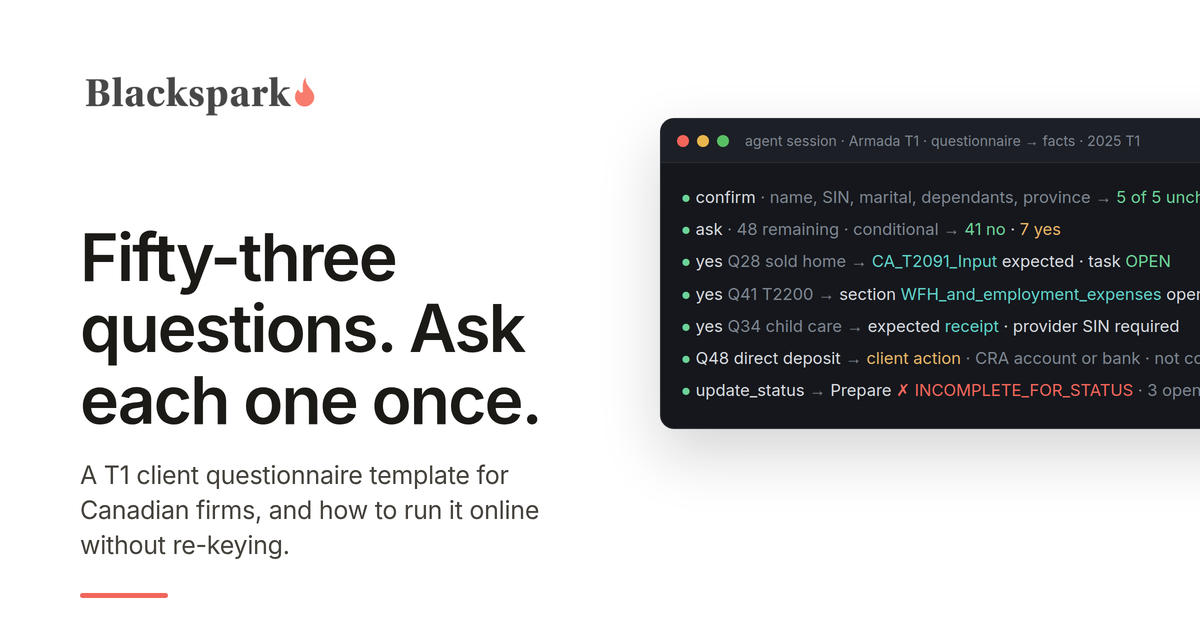
Level three: facts on the file. The questionnaire stops being a document and becomes the file's own set of facts, each recorded once with a date and a source ("client confirmed, March 3"), carried forward every year, and confirmed rather than re-asked. The question about a home sale is not a form field; it is a fact whose "yes" creates the expectation of a disposition record and a task to collect the details. The question about a T2200 is a fact whose "yes" opens the employment expense section and whose "no" closes it. This is what intake looks like when an AI agent runs it in Armada T1: the agent asks the client only the questions whose answers are missing or stale, records the answers as structured facts, turns each "yes" into the document requests and tasks it implies, and never advances the file until the completeness check passes. We have shown the full loop for a firm whose practice management platform has an API and for one on Jetpack Workflow and Google Drive, with no API at all; the questionnaire is the same in both.
Whichever level you are at, three rules make the questionnaire work.
Ask once. Anything marked "confirm" should be pre-filled. A client who types their SIN and date of birth every year learns that the firm does not remember them, and a firm that re-collects a SIN through a form every year is creating a copy it now has to protect.
Every "yes" must go somewhere. A yes on question 28 should produce a request for the sale details, a yes on 34 a request for the child care receipt, a yes on 41 the expense schedule. If a yes only produces a tick in a box that a preparer reads in April, the questionnaire has captured the fact and then lost it.
Re-audit the questions every year. Credits expire and rules change. The list above reflects the 2025 tax year; the digital news subscription credit, for example, was only available for 2020 to 2024 and does not belong on a 2025 questionnaire, though it is still on many. Whoever owns the questionnaire should read the CRA's what's-new page each January before changing the year in the header.
What to do with the answers
Once the answers are in, the questionnaire's fifty-three facts collapse into a short set of consequences for the file: which sections exist (employment, self-employment, rental, capital dispositions, foreign reporting), which documents are expected beyond what Auto-fill my return will deliver, which follow-ups go to the client and which to the preparer, and which items need a human decision before anything is entered. That mapping is the real product of the questionnaire, and it is the part worth automating first, because it is the same for every client and it is where the "the questionnaire said yes but nobody noticed" errors come from.
If you are doing it by hand, the T1 intake checklist is the document side of the same process, and the tax organizer post covers the software options at each level. If you want to see the questionnaire run as facts on a file, with the follow-ups routed automatically, request access to Armada T1.
This post provides general information for tax professionals and is not tax, legal, or filing advice. The template reflects CRA rules for the 2025 tax year as published in September 2026 and should be adapted to your client base and province and reviewed each year. TaxDome, Karbon, and Jetpack Workflow are trademarks of their respective owners, and no partnership or endorsement is implied.
